
 Call:
 Mail:
A hotel can have beautiful rooms, modern facilities, premium interiors, and advanced technology.
But none of these guarantee a great guest experience.
A guest may remember the design of a hotel, but they experience the hotel through its people.
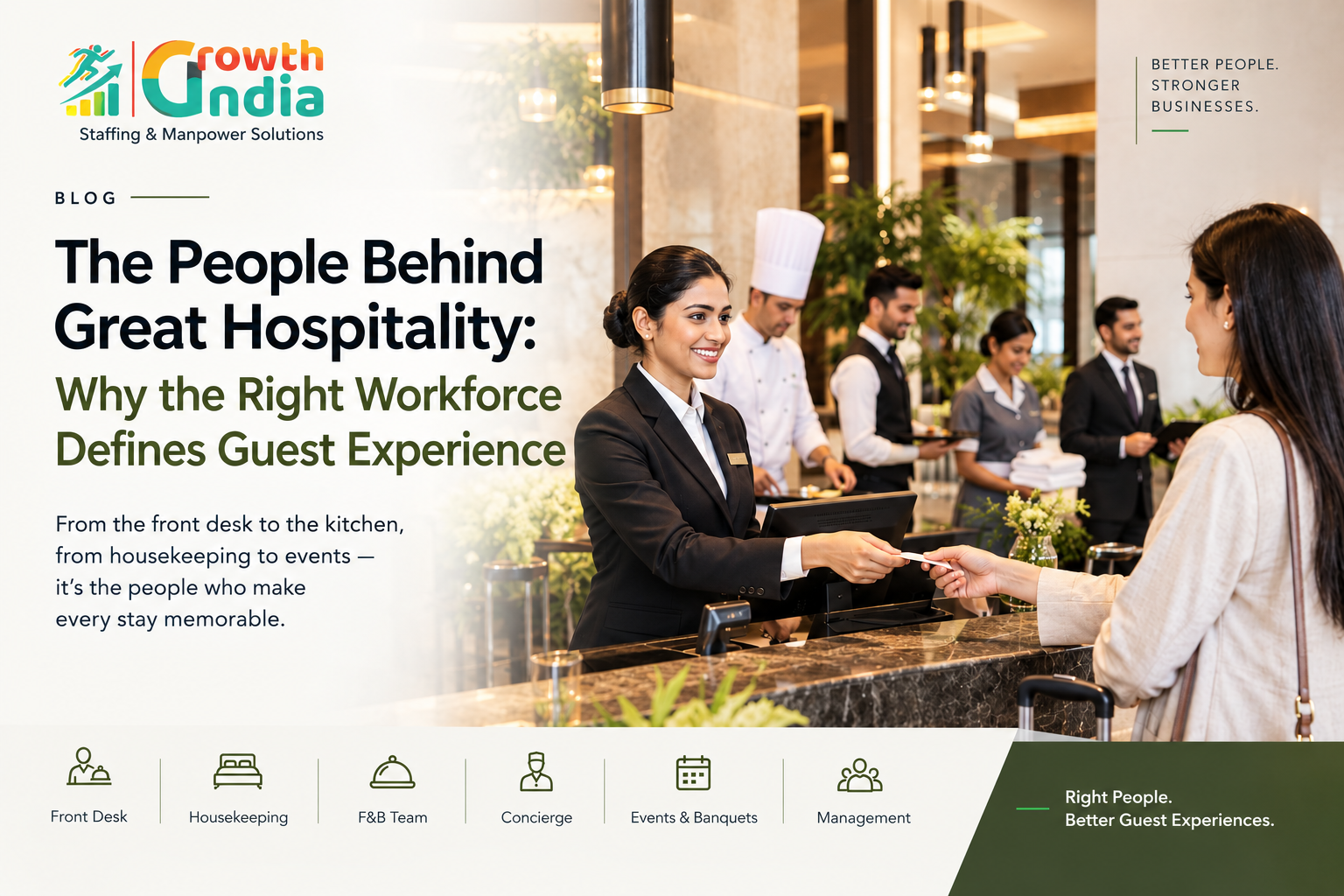
From the receptionist who welcomes them at the front desk to the housekeeping professional who prepares their room, from the restaurant team serving their meal to the manager resolving an unexpected issue — every employee contributes to how a guest perceives the property.
This is why, in the hospitality industry, the workforce is not just an operational requirement. It is a major part of the guest experience.
Every Guest Journey Is a People Journey
Think about a typical hotel stay.
A guest first interacts with the hotel during the booking process. Then comes check-in, room service, housekeeping, dining, concierge services, events, and finally checkout.
At almost every stage, a person is responsible for delivering the experience.
1. Reservation & Booking Team
The guest experience can begin even before the guest enters the hotel.
Reservation teams handle enquiries, bookings, availability, special requests, and communication with guests.
A professional and responsive reservation team can create confidence before the stay even begins.
2. Front Desk & Reception
The front desk is often the first physical interaction a guest has with the hotel.
Check-in efficiency, communication, professionalism, and problem-solving can immediately influence the guest’s perception.
A delayed check-in or poor interaction may seem like a small operational issue, but for a tired traveller arriving after a long journey, it can become the first negative impression of the entire property.
3. Housekeeping
Cleanliness is one of the most fundamental expectations in hospitality.
Housekeeping teams are responsible for maintaining rooms, common areas, hygiene standards, and overall comfort.
Guests may not always notice excellent housekeeping consciously — but they certainly notice when it is missing.
4. Food & Beverage Team
Restaurants, room service, cafés, banquets, and other F&B operations require coordination between multiple employees.
Chefs, servers, supervisors, and support staff all contribute to the dining experience.
A correct order, timely service, professional communication, and consistent quality can turn a routine meal into a memorable part of the stay.
5. Concierge & Guest Services
Hospitality is also about personalization.
Guests may need assistance with transportation, local recommendations, reservations, special requests, or other services.
A capable guest-services team can make these interactions smooth and personalized instead of making the guest feel like just another booking number.
6. Events & Banquet Teams
Hotels frequently host conferences, weddings, corporate meetings, celebrations, and other events.
These operations require precise coordination.
From setup and food service to guest management and last-minute problem-solving, event staff can directly influence whether an event feels seamless or chaotic.
7. Management & Operations
Behind all these functions is the management team.
Hotel managers and operations professionals coordinate people, resources, service standards, guest complaints, compliance, and day-to-day operations.
Their decisions influence the performance of almost every other department.
The Cost of the Wrong Workforce
Hospitality businesses don’t simply need more employees.
They need the right employees for the right roles.
Hiring too quickly without considering skills, experience, communication, role suitability, or cultural fit can create operational problems.
For example:
Wrong role fit → Poor performance → Operational delays → Guest dissatisfaction
A staffing gap can also put additional pressure on existing employees.
When teams are understaffed, employees may have to handle more responsibilities than they can reasonably manage. Over time, this can affect service quality, productivity, and employee satisfaction.
In hospitality, these problems can become visible to the customer very quickly.
One delayed check-in.
One poorly prepared room.
One incorrect order.
One unresolved complaint.
One poor interaction.
Small employee-level problems can become big customer-level problems.
It’s Not About Having More People. It’s About Having the Right People.
One common mistake in workforce planning is focusing only on headcount.
But headcount alone doesn’t guarantee service quality.
A hotel may have enough employees on paper and still struggle operationally if employees are not properly matched to their roles.
The better question is:
Do we have the right people at every guest touchpoint?
That means considering factors such as:
- Relevant hospitality experience
- Communication skills
- Role-specific capabilities
- Professional behaviour
- Availability and workforce requirements
- Ability to work in a fast-paced environment
- Understanding of service standards
- Fit with the organisation’s operational requirements
The objective is not simply to fill vacancies.
The objective is to build a workforce capable of delivering the expected guest experience.
Permanent, Temporary & Contract Staffing: Different Needs Require Different Solutions
Hospitality businesses don’t always have the same workforce requirements throughout the year.
Demand can change because of:
- Seasonal tourism
- Weddings and events
- Holidays
- Business conferences
- New property openings
- Expansion into new locations
- Temporary workforce shortages
- Changes in operational requirements
Because of this, businesses may require different staffing models depending on the situation.
Permanent Staffing
Suitable for long-term roles where businesses need stable teams and continuity.
Temporary Staffing
Useful when businesses experience short-term increases in workforce demand or need immediate operational support.
Contract Staffing
Can provide flexibility for specific projects, operational requirements, or defined periods.
Choosing the right staffing model allows hospitality businesses to manage workforce requirements without treating every hiring need the same way.
Why Hospitality Staffing Requires Industry Understanding
Hospitality recruitment is different from simply filling general vacancies.
Different roles require different combinations of technical ability, communication, professionalism, service orientation, and operational experience.
For example, the requirements of a front-office professional are different from those of a chef, housekeeping executive, banquet employee, or hotel manager.
That means recruitment needs to consider the actual responsibilities of the position rather than simply matching a candidate to a job title.
A staffing partner with an understanding of hospitality requirements can help businesses approach recruitment more systematically.
How Growth India Supports Hospitality Staffing
Growth India provides staffing and manpower solutions for businesses across different industries, including the hospitality sector.
For hospitality businesses, the focus is on helping organisations identify and recruit talent according to their workforce requirements.
This can include roles across areas such as:
- Front Office
- Housekeeping
- Food & Beverage
- Restaurant Operations
- Reservations
- Guest Services
- Events & Banquets
- Operations
- Management
- Other specialised hospitality requirements
Growth India’s recruitment approach can support businesses with different workforce needs, including permanent, temporary, and contract staffing requirements.
The goal is straightforward:
Help businesses find the people they need to keep their operations running effectively.
Building Better Hospitality Starts With Building Better Teams
Technology can improve hotel operations.
Beautiful interiors can attract guests.
Marketing can bring customers through the door.
But the actual experience is delivered by people.
The receptionist who handles the first interaction.
The housekeeping professional who prepares the room.
The chef who prepares the meal.
The server who delivers it.
The concierge who solves a problem.
The manager who handles an unexpected situation.
Together, these people become the face of the hotel.
That’s why workforce strategy should not be treated as a back-office activity.
It is part of the guest-experience strategy.
Final Thought
A successful hospitality business doesn’t simply provide a room, a meal, or an event venue.
It provides an experience.
And that experience is delivered by people.
So the real question for every hospitality business isn’t:
“How many people do we need?”
It is:
“Do we have the right people to deliver the experience our guests expect?”
Because ultimately:
Great hospitality isn’t built by facilities alone.
It’s built by the people behind them.
About Growth India
Growth India is a staffing and manpower solutions company helping businesses with recruitment and workforce requirements across multiple industries, including hospitality.
To learn more about Growth India’s staffing and manpower solutions, visit:
growthindia.co

Leave A Comment