
 Call:
 Mail:
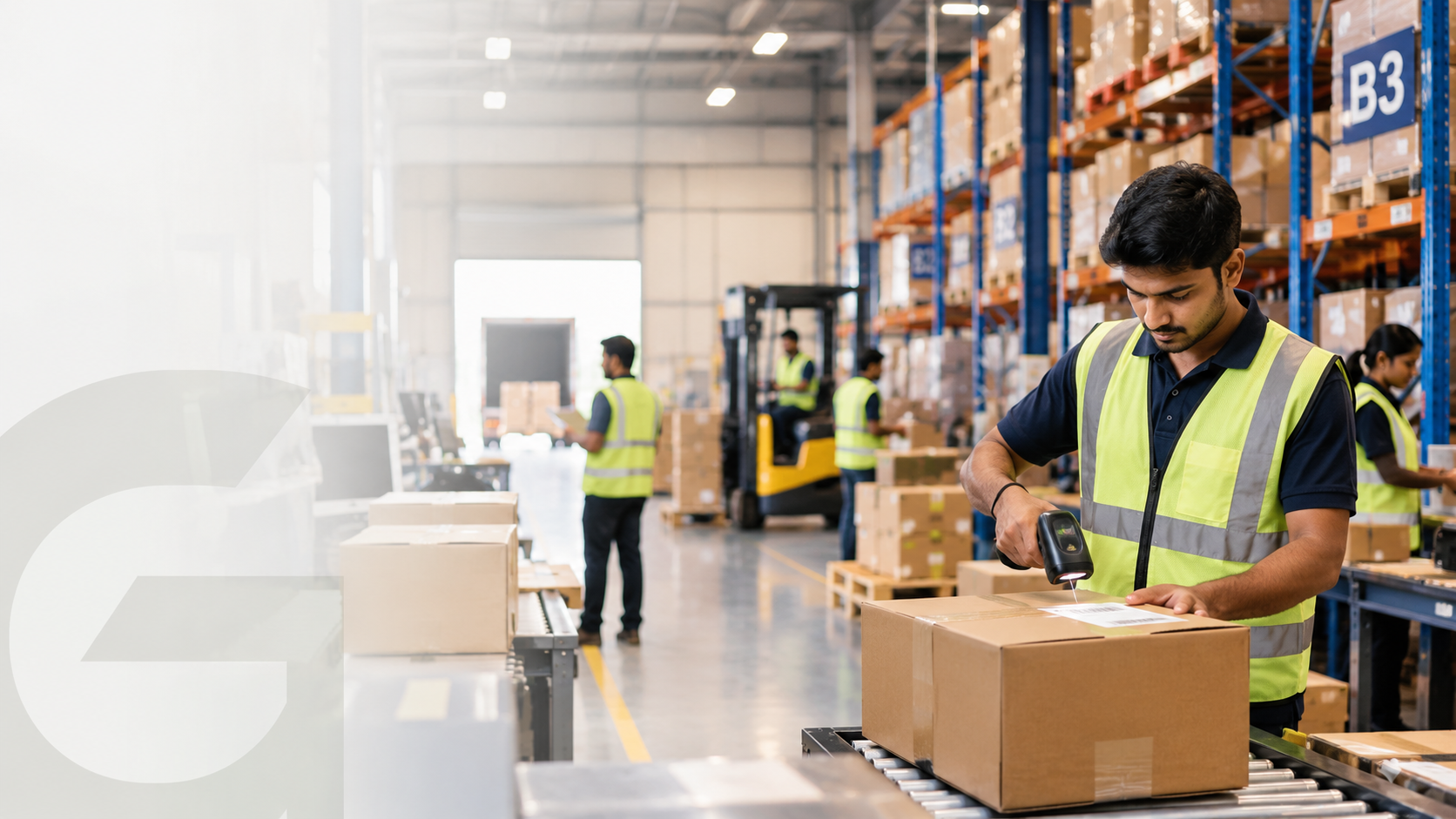
When a customer places an order online, they usually see only one thing:
“Order Delivered.”
But between clicking Buy Now and receiving that package, there is an entire operation working behind the scenes.
Products need to be received and verified.
Inventory needs to be stored correctly.
Orders need to be picked accurately.
Products need to be packed safely.
Shipments need to be dispatched on time.
And behind every one of these steps are people, processes, and technology working together.
That is why a modern warehouse is much more than a place where products are stored.
It is a critical engine of fulfillment — and the right workforce can directly influence how fast, accurately, and efficiently that engine runs.
A Warehouse Is the Beginning of the Delivery Experience
Customers may never see a warehouse employee.
They may never know where their order was stored, who picked it from the rack, who packed it, or who prepared it for dispatch.
But they experience the results of those actions.
A correctly picked product means fewer errors.
Proper packing means fewer damaged shipments.
Accurate inventory means fewer cancelled orders.
Faster processing means quicker fulfillment.
So while the warehouse operates behind the scenes, its performance directly affects what the customer experiences.
Fast delivery doesn’t start with the delivery vehicle.
It starts inside the warehouse.
From Order to Dispatch: Where Workforce Matters
A typical fulfillment cycle involves several connected stages.
1. Receiving
When inventory arrives at a warehouse, products need to be unloaded, checked, counted, verified, and recorded.
An inefficient receiving process can create bottlenecks before products even enter storage.
A trained workforce helps ensure that incoming inventory is processed systematically and accurately.
2. Storage
Where products are placed inside a warehouse matters.
Poor storage layouts can increase picker travel time, slow replenishment, create congestion, and make inventory difficult to locate.
Modern warehouse operations therefore require more than physical storage space.
They require:
- Efficient layouts
- Proper product placement
- Inventory organisation
- Effective space utilisation
- Well-trained warehouse personnel
The objective is simple:
Put the right product in the right place so that it can be found quickly when required.
3. Picking
Picking is one of the most important stages of order fulfillment.
Employees need to identify the correct product, locate it, pick the required quantity, and move it to the next stage.
A picking error doesn’t simply create a warehouse problem.
It can result in:
Wrong Product → Customer Complaint → Return → Additional Cost → Lost Time
This is why picking accuracy and workforce training are critical.
4. Packing
Once products are picked, they need to be packed correctly.
The packing team has to ensure that:
- The correct items are included
- Quantities are accurate
- Products are protected
- Labels are correctly applied
- Orders are ready for dispatch
Efficient packing helps maintain both speed and accuracy.
5. Dispatch
The final warehouse stage is getting the order ready to leave the facility.
This requires coordination between warehouse teams, inventory, transportation, and dispatch operations.
A delay at this stage can affect the entire delivery timeline.
That’s why a warehouse needs a workforce that can maintain consistent throughput even when order volumes increase.
The Real Challenge: Scaling During Peak Demand
Warehouse demand isn’t always constant.
Businesses can experience sudden increases during:
- Festive seasons
- E-commerce sales
- Product launches
- Promotional campaigns
- Seasonal demand
- Business expansion
A warehouse designed for normal volume may struggle when orders suddenly increase.
This creates a major workforce challenge.
How do you increase operational capacity without permanently increasing your workforce?
This is where flexible staffing becomes important.
Temporary and contract staffing can help businesses respond to short-term workforce requirements without treating every demand spike as a permanent hiring requirement.
Growth India’s recruitment services include permanent, temporary, and contract-based staffing, allowing businesses to approach workforce requirements according to their operational needs.
Technology Alone Doesn’t Run a Warehouse
Modern warehouses increasingly rely on technology.
Warehouse Management Systems can help manage inventory, storage, movement, and fulfillment processes.
But technology doesn’t eliminate the need for people.
Someone still has to:
Receive → Store → Pick → Pack → Dispatch
Technology can provide information and structure.
People execute the physical operation.
This is why the strongest warehouse operations don’t treat technology and manpower as alternatives.
They combine both.
Technology provides visibility.
Processes provide structure.
People provide execution.
Why Workforce Quality Matters More Than Headcount
Having more employees doesn’t automatically mean having a faster warehouse.
In fact, adding people without proper processes can sometimes create more congestion and coordination problems.
What matters is having:
- The right number of employees
- The right skills
- Clear responsibilities
- Proper training
- Effective supervision
- Cross-functional capabilities
- Performance monitoring
For example, a trained picker who understands warehouse processes can potentially contribute more effectively than multiple poorly trained workers operating without a clear system.
The objective isn’t:
“Hire more people.”
The objective is:
“Deploy the right people where they create the most operational value.”
Measuring Warehouse Performance
A warehouse cannot improve what it doesn’t measure.
Some important operational indicators include:
Inventory Accuracy
How closely physical inventory matches system records.
Picking Accuracy
How frequently orders are picked correctly.
Order Processing Time
How long it takes to process an order from receipt to dispatch.
Throughput
How much inventory or how many orders the warehouse can process within a given period.
Labour Productivity
How efficiently the workforce performs assigned operations.
Turnaround Time
How quickly goods move through receiving, processing, and dispatch.
These metrics help warehouse operators identify bottlenecks and continuously improve performance.
People + Process + Technology
The most effective warehouse operations don’t depend on one factor.
They combine three critical components:
PEOPLE
Skilled and reliable employees who understand their responsibilities.
PROCESS
Structured workflows for receiving, storage, picking, packing, and dispatch.
TECHNOLOGY
Systems that provide visibility, inventory control, operational data, and process support.
When these three work together, warehouses can become faster, more accurate, and more scalable.
How Growth India Approaches Warehouse Management
Growth India positions its Warehouse Management service around a combination of manpower expertise and operational processes.
According to its current service offering, Growth India manages 500+ full-time 3PL employees, 1.8M+ sq. ft. of warehouse space, and 20+ warehouses and delivery centres.
Its warehouse-management approach includes:
Efficient Manpower Deployment
Structured allocation of trained personnel to support smooth warehouse operations and respond to changes in workload.
Optimised Storage & Layouts
Using WMS-driven strategies for storage, slotting, layout design, and inventory movement to reduce unnecessary movement and improve throughput.
Faster Fulfillment Cycles
Coordinating receiving, loading, unloading, picking, packing, and dispatch to improve turnaround times.
Continuous Operational Improvement
Using approaches such as Lean methodologies, 5S implementation, and KPI-driven performance reviews.
Skilled Workforce
Focusing on training, cross-functional capabilities, and workforce reliability to support consistent operations.
Integrate. Store. Ship.
A well-designed warehouse operation can be understood through three simple stages.
Integrate
Inventory enters the fulfillment centre and goes through receiving and verification.
Store
Products are placed strategically to optimise space and enable faster access.
Ship
Orders move through the Pick → Pack → Dispatch process before leaving the facility.
The objective is not simply to store more products.
It is to move products through the system efficiently.
The Future of Warehousing Is About Speed and Precision
Customer expectations are changing.
People increasingly expect:
- Faster delivery
- Accurate orders
- Real-time visibility
- Reliable availability
- Fewer errors
- Consistent service
Meeting these expectations requires warehouses to become more efficient and adaptable.
Automation and software will continue to play a bigger role.
But even the best technology requires capable people to operate, monitor, and improve the underlying processes.
The warehouse of the future therefore won’t simply be more automated.
It will be better integrated.
People, technology, data, and processes will work together to create faster fulfillment.
Final Thought
A warehouse is not simply a building filled with products.
It is a system.
Every receiving decision, every inventory movement, every picking action, every packed order, and every dispatch contributes to the final customer experience.
And behind that system are people.
So when businesses think about improving fulfillment, the question shouldn’t only be:
“How much warehouse space do we have?”
It should also be:
“Do we have the right workforce to make that space work efficiently?”
Because ultimately:
A warehouse doesn’t create faster fulfillment by storing products better alone.
It creates faster fulfillment when the right people, processes, and technology work together.
About Growth India
Growth India is a staffing and manpower solutions company providing recruitment and workforce services across multiple industries, including logistics and warehousing.
Its Warehouse Management solutions combine workforce deployment, operational processes, and technology-driven approaches to help businesses manage inventory flow and fulfillment operations more efficiently.
Right People. Better Operations. Faster Fulfillment.
🌐 growthindia.co

Leave A Comment