
 Call:
 Mail:
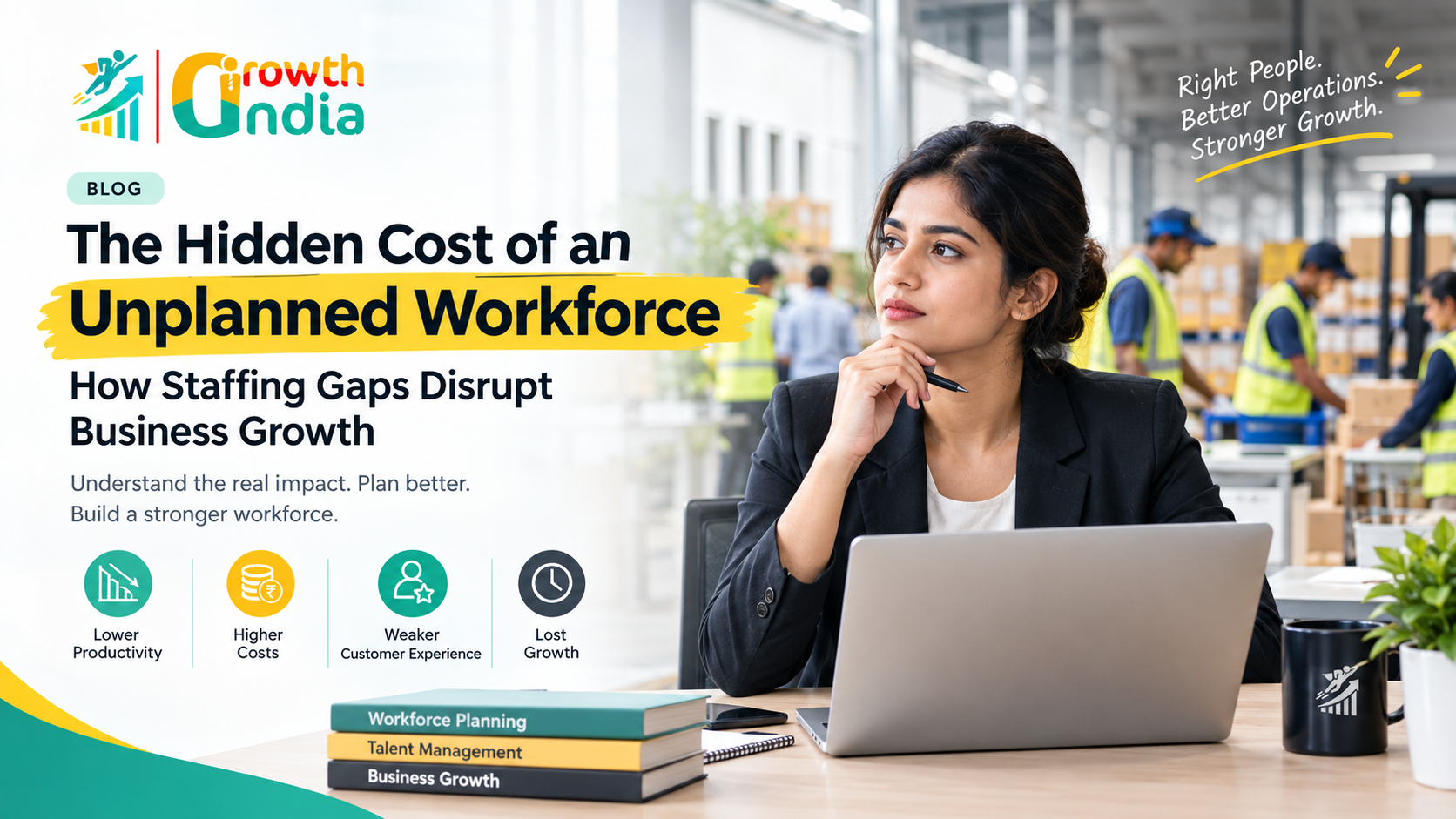
A Growth India Blog | Workforce Management | Business Growth
Introduction: When Workforce Gaps Become Business Problems
Business growth is often measured through revenue, customer acquisition, market expansion, and operational performance. However, one critical factor is frequently overlooked: having the right people available at the right time, in the right roles.
Imagine a company preparing to fulfil a major customer order, launch a new service, or expand into another city. The infrastructure is ready, the demand is there, and the business strategy is clearly defined. Yet, the operation struggles because there are not enough employees to handle the workload.
Deadlines begin to slip. Existing employees take on additional responsibilities. Managers spend their time solving staffing emergencies instead of improving performance. Eventually, customers may experience delays or inconsistent service.
This is how an unplanned workforce can quietly restrict business growth.
Staffing gaps are not always the result of a shortage of available candidates. They can also arise from poor workforce forecasting, unexpected employee absences, high turnover, ineffective scheduling, or a mismatch between employee skills and operational requirements.
For businesses aiming to grow sustainably, workforce planning must become more than an HR activity. It must be an integral part of business strategy.
1. Understanding the Real Cost of Staffing Gaps
A staffing gap occurs when an organisation does not have enough employees, the necessary skills, or the appropriate workforce availability to meet its operational requirements.
While the immediate problem may appear to be an unfilled position, its consequences can extend across the entire business.
Reduced Productivity and Operational Efficiency
When a team operates below its required capacity, the remaining employees often have to manage additional tasks. Although this may help maintain operations temporarily, it can create an unsustainable workload.
Employees may struggle to maintain the same level of efficiency, managers may find it difficult to distribute responsibilities, and routine processes may take longer to complete.
For example, if a warehouse operates with fewer workers than required during a high-demand period, order processing, packaging, and dispatch may slow down. Even a well-organised supply chain can experience delays when the workforce cannot support the required volume.
Increased Labour and Overtime Costs
Unexpected staffing shortages can force businesses to rely on overtime, emergency recruitment, temporary replacements, or last-minute schedule changes.
These measures can be necessary, but frequent dependence on them may increase operating costs.
The problem becomes more significant when organisations focus only on the immediate expense of filling a vacancy rather than calculating the broader cost of the staffing gap.
A more complete assessment should consider overtime payments, recruitment expenses, training time, lost output, and the additional workload placed on supervisors.
Customer Experience and Service Quality
Employees directly influence the quality and consistency of customer experiences.
Inadequate staffing can result in longer response times, delayed deliveries, slower service, or reduced attention to customer requirements.
In industries such as hospitality, healthcare support, retail, logistics, and facility management, workforce availability can directly affect day-to-day service delivery.
A business may invest heavily in marketing to attract customers, but poor operational execution can weaken the value of that investment.
Management Time Diverted From Growth
When staffing problems become frequent, managers are forced to spend more time filling shifts, coordinating replacements, resolving workload issues, and addressing operational complaints.
This reduces the time available for strategic activities such as process improvement, employee development, customer relationships, and business expansion.
The hidden cost is not simply the missing employee. It is also the productive time lost across the organisation because that position remains unfilled or inadequately covered.
2. Why Do Workforce Gaps Occur?
Understanding the causes of staffing gaps is the first step towards preventing them. In many organisations, these challenges develop gradually because workforce requirements are not reviewed alongside changing business needs.
Reactive Hiring Instead of Workforce Planning
Some businesses begin recruitment only after a vacancy appears or a manager reports that a team is understaffed.
This reactive approach can work for occasional vacancies, but it becomes less effective when demand fluctuates, multiple positions need to be filled, or specialist skills are required.
Recruitment takes time. If businesses wait until a staffing problem becomes urgent, they may have limited options and less time to evaluate candidates properly.
Proactive workforce planning helps organisations anticipate demand and prepare recruitment or internal training activities in advance.
Unexpected Absenteeism and Employee Turnover
Employee absences and resignations are normal workplace realities. The operational risk increases when organisations have no reliable process for managing them.
When a critical employee becomes unavailable, responsibilities may remain uncovered, particularly in teams where only a small number of people possess the required skills.
Similarly, frequent employee turnover can create a continuous cycle of recruitment, onboarding, training, and adjustment.
Businesses need to understand not only how many employees they have, but also which roles are critical, where replacement risks exist, and how quickly those roles can be covered.
Inaccurate Demand Forecasting
Workforce requirements often change with business activity.
Retailers may need additional employees during seasonal demand. Logistics companies may experience fluctuations in shipment volumes. Hospitality businesses may require different staffing levels depending on occupancy and events.
If workforce planning relies only on historical headcount rather than actual operational demand, organisations may find themselves either understaffed during busy periods or carrying unnecessary labour costs during quieter periods.
Skills Mismatch
Having enough employees does not automatically mean having the right workforce.
A business may have sufficient headcount but still lack employees with the technical knowledge, customer-handling ability, certifications, or practical experience required for specific responsibilities.
Effective workforce planning must therefore consider both workforce quantity and workforce capability.
3. The Difference Between Filling Vacancies and Building Workforce Readiness
Recruitment and workforce planning are closely connected, but they solve different problems.
Recruitment focuses on identifying, assessing, and hiring suitable candidates for available positions. Workforce planning looks more broadly at the organisation’s current capabilities, future requirements, potential risks, and available options for meeting business demand.
A company that focuses exclusively on filling vacancies may repeatedly respond to the same staffing problems.
A company that builds workforce readiness asks different questions:
- Which roles are essential to maintaining business operations?
- How will workforce requirements change over the next quarter or year?
- Which skills are becoming difficult to source?
- What happens if a key employee leaves unexpectedly?
- Can existing employees be trained or redeployed to meet changing requirements?
- When should external recruitment or staffing support be introduced?
These questions help organisations move from emergency hiring towards a more structured and sustainable approach.
Research and guidance published by the Society for Human Resource Management emphasise integrating workforce planning with business strategy, using workforce data, and reviewing plans as organisational needs change.
The central principle is straightforward: staffing decisions should reflect where the business is going, not only the vacancies it has today.
4. How Staffing Gaps Affect Different Industries
The consequences of workforce shortages vary by industry, but the underlying challenge remains similar: operational requirements must be matched with workforce availability and capability.
Manufacturing and Industrial Operations
Manufacturing businesses depend on coordinated production activities, equipment availability, quality control, and shift coverage.
A shortage of appropriately trained personnel can disrupt production schedules, increase pressure on existing teams, and delay order fulfilment.
Planning must account for production volumes, shift requirements, employee skills, training needs, and backup arrangements for critical positions.
Logistics and Supply Chain
Logistics operations depend on timely coordination across warehousing, inventory handling, transportation, and dispatch.
Insufficient workforce availability during peak demand can slow down order processing and affect delivery commitments.
Businesses can reduce this risk by forecasting demand, planning shift coverage, and preparing for predictable periods of increased activity.
Hospitality and Customer Services
Hospitality businesses must maintain service quality while responding to changing customer volumes.
When staffing levels do not match operational demand, employees may become overloaded and customers may experience inconsistent service.
Workforce planning should account for expected occupancy, reservations, events, service hours, and the skills required for different responsibilities.
Healthcare Support and Facility Management
Healthcare support and facility management operations depend on reliable coverage, appropriate skills, and clearly defined responsibilities.
Gaps in essential roles can create service disruptions and increase pressure on the employees who remain available.
In these environments, workforce planning must also account for relevant qualifications, safety requirements, applicable labour regulations, and continuity of essential services.
Across all these sectors, the objective is not simply to employ more people. It is to maintain the workforce capacity needed to deliver consistent results.
5. Five Practical Ways to Reduce Workforce Gaps
Businesses do not need an unnecessarily complicated system to begin improving workforce readiness. A structured process, supported by accurate information and clear accountability, can make a meaningful difference.
1. Forecast Workforce Demand
Start by reviewing business activity, expected growth, seasonal patterns, planned projects, and historical staffing requirements.
Identify the departments and roles most likely to experience shortages.
Forecasting does not eliminate uncertainty, but it gives decision-makers more time to prepare for likely changes.
2. Identify Critical Roles and Staffing Risks
Not every vacancy has the same operational impact.
Identify positions that directly influence production, customer service, compliance, safety, or business continuity.
For each critical role, assess the time required to recruit a replacement, the availability of suitable internal employees, and the consequences of an unexpected absence.
This helps organisations prioritise recruitment and backup planning based on business risk rather than treating every vacancy equally.
3. Improve Employee Retention and Development
Recruiting new employees is only one way to address workforce shortages.
Organisations should also examine why employees leave, whether workloads are manageable, whether expectations are clear, and whether employees have opportunities to develop relevant skills.
Training existing employees, improving onboarding, supporting managers, and creating transparent career paths can help preserve valuable organisational knowledge.
Retention is not a substitute for recruitment, but a stronger retention strategy can reduce avoidable disruption.
4. Build Flexible Staffing Arrangements Where Appropriate
Some businesses experience workforce requirements that fluctuate significantly throughout the year.
Depending on the role, industry, and applicable employment requirements, organisations may consider temporary staffing, contract-based arrangements, project-based hiring, or other flexible workforce models.
These arrangements can help businesses respond to changing demand without relying entirely on permanent headcount expansion.
However, flexibility should not come at the expense of worker protections, proper onboarding, service quality, or legal compliance. The arrangement must fit the actual operational requirement.
5. Track Workforce Performance Metrics
Workforce decisions become more effective when managers can identify patterns rather than relying only on assumptions.
Useful metrics include:
- Vacancy rate: The proportion of approved positions that remain unfilled.
- Time to fill: The time required to fill a vacancy.
- Absenteeism rate: The proportion of scheduled working time lost to employee absence, measured using a consistent definition.
- Employee turnover rate: The proportion of employees leaving during a defined period.
- Overtime hours: The amount of additional working time required beyond normal schedules.
- Productivity indicators: Output, service volume, or completed work relative to available workforce capacity.
- Workforce coverage: The extent to which required roles and shifts are adequately staffed.
These metrics should be reviewed together. For example, a low vacancy rate may appear positive, but high overtime and absenteeism could still indicate that a team is operating under excessive pressure.
The goal is to identify emerging problems early and make decisions using evidence.
6. Calculating the Hidden Cost of a Staffing Gap
One of the biggest mistakes businesses make is treating staffing gaps as an HR expense instead of an operational cost.
A simple cost framework can help management understand the potential financial impact.
Consider a hypothetical example of a business experiencing a shortage of five employees for one month.
| Cost component | Illustrative monthly cost |
|---|---|
| Additional overtime | ₹25,000 |
| Temporary replacement or coverage expenses | ₹15,000 |
| Estimated contribution lost through delayed or reduced output | ₹30,000 |
| Total estimated impact | ₹70,000 |
These figures are illustrative only, not industry benchmarks. Actual costs depend on the business, role, location, workload, and duration of the shortage.
The calculation also needs to avoid double-counting. For instance, lost output should not be counted separately if its financial impact is already fully reflected in another cost category.
A more complete assessment can include recruitment costs, onboarding time, quality issues, rework, customer service impacts, and additional supervisory effort where these can be measured reliably.
Once organisations understand the potential cost, they can compare the expense of preventive workforce planning with the cost of repeatedly responding to staffing emergencies.
The objective is not to eliminate every vacancy. It is to reduce avoidable disruption and make workforce investment more effective.
7. The Role of a Reliable Staffing Partner
Internal HR teams play an important role in recruitment, employee management, and workforce planning. However, businesses facing rapid expansion, multiple vacancies, specialised hiring needs, or changing staffing requirements may benefit from additional recruitment and staffing support.
A reliable staffing partner can help organisations source suitable candidates, coordinate recruitment activities, support workforce scaling, and reduce the administrative pressure associated with hiring.
The value of a staffing partnership depends on more than the number of candidates supplied. It also depends on role clarity, candidate suitability, communication, hiring timelines, service expectations, and compliance with applicable requirements.
Before selecting a staffing partner, businesses should evaluate:
- Understanding of the organisation’s industry and workforce requirements.
- Ability to source candidates with relevant skills and experience.
- Recruitment processes and candidate screening standards.
- Communication, reporting, and replacement arrangements.
- Transparency around fees, service terms, and responsibilities.
- Compliance practices relevant to the engagement.
For growing businesses, the right partnership can complement internal HR capabilities and provide additional support when workforce requirements exceed existing capacity.
8. Workforce Planning Is a Business Growth Strategy
Workforce planning should not be limited to periods when an organisation is struggling to hire.
It should be part of routine business planning, alongside budgeting, sales forecasting, operational targets, and expansion decisions.
When an organisation plans to enter a new market, launch a service, increase production, or expand its customer base, it should also evaluate the people and skills required to execute that strategy.
This requires regular collaboration between business leaders, HR teams, finance, and operations.
A practical workforce planning cycle includes:
- Assess current capacity: Understand existing headcount, skills, productivity, and coverage.
- Forecast future demand: Estimate the workforce needed to support upcoming business activity.
- Identify gaps: Compare current capabilities with projected requirements.
- Choose interventions: Consider recruitment, training, internal mobility, improved scheduling, or appropriate external staffing support.
- Review results: Monitor workforce metrics and adjust plans as business conditions change.
This process does not need to be complex to be useful. Even a basic quarterly review can help businesses identify risks earlier than a purely reactive approach.
Ultimately, workforce planning connects people decisions with business priorities. It helps organisations prepare for growth while maintaining operational stability.
Conclusion: Growth Requires More Than Hiring
A business can have a strong product, a clear strategy, and a growing customer base, yet struggle to achieve its potential if its workforce cannot support its operational needs.
Staffing gaps can increase costs, reduce productivity, place pressure on existing employees, and affect customer experience. When these issues are addressed only after they become urgent, organisations risk repeating the same cycle of disruption.
The solution is not simply to hire more people. It is to understand workforce demand, anticipate critical shortages, develop existing talent, establish appropriate staffing arrangements, and measure performance consistently.
Businesses that treat workforce planning as a strategic priority are better positioned to respond to changing requirements and support sustainable growth.
At Growth India, we recognise that workforce requirements differ across industries and business stages. Our recruitment and manpower solutions are designed to support organisations in identifying suitable talent and addressing their workforce requirements.
Whether your organisation is expanding operations, managing changing staffing needs, or preparing for its next phase of growth, a more structured approach to workforce planning can help create a stronger operational foundation.
Plan your workforce today to be better prepared for tomorrow.
Explore Growth India’s workforce and recruitment solutions at growthindia.co or contact our team at service@growthindia.co to discuss your business requirements.
Frequently Asked Questions (FAQs)
1. What is workforce planning?
Workforce planning is the process of assessing an organisation’s current employees and skills, forecasting future workforce requirements, identifying gaps, and deciding how to address them through recruitment, training, redeployment, or other appropriate arrangements.
2. How do staffing gaps affect business growth?
Staffing gaps can delay operations, increase overtime expenses, reduce productivity, affect service quality, and divert management attention from strategic priorities. Their impact depends on the role, duration of the shortage, and importance of the affected operation.
3. What causes workforce shortages in businesses?
Common causes include reactive hiring, employee turnover, unexpected absences, inaccurate demand forecasts, skills mismatches, seasonal demand, and insufficient workforce planning.
4. How can businesses reduce staffing gaps?
Businesses can forecast workforce demand, identify critical roles, improve employee retention, train existing employees, prepare backup coverage, use suitable staffing arrangements, and regularly monitor workforce performance metrics.
5. When should a company consider external staffing support?
External staffing support may be useful when a company needs to fill multiple vacancies, expand into new locations, respond to seasonal demand, source specialised talent, or supplement its internal recruitment capacity.
6. Is workforce planning relevant to small and medium-sized businesses?
Yes. Smaller businesses may be particularly vulnerable when a critical employee becomes unavailable because fewer people are available to cover the responsibilities. Basic workforce forecasting, cross-training, and backup planning can help reduce this risk.
7. How can Growth India support business workforce requirements?
Growth India provides recruitment and manpower solutions to support organisations with their workforce needs. Businesses can contact the team to discuss their requirements and determine the appropriate support for their operations.
Suggested final CTA: Need the right workforce for your next stage of growth? Connect with Growth India to discuss your recruitment and manpower requirements.
Contact: service@growthindia.co
Website: https://growthindia.co/
Suggested SEO keywords: workforce planning, staffing gaps, manpower solutions, workforce management, recruitment services, business growth, employee productivity, staffing solutions in India.
Editorial note: Review the final service description and any linked service pages before publishing to ensure the wording accurately reflects Growth India’s current offerings.

Leave A Comment