
 Call:
Call:  Mail:
Mail: 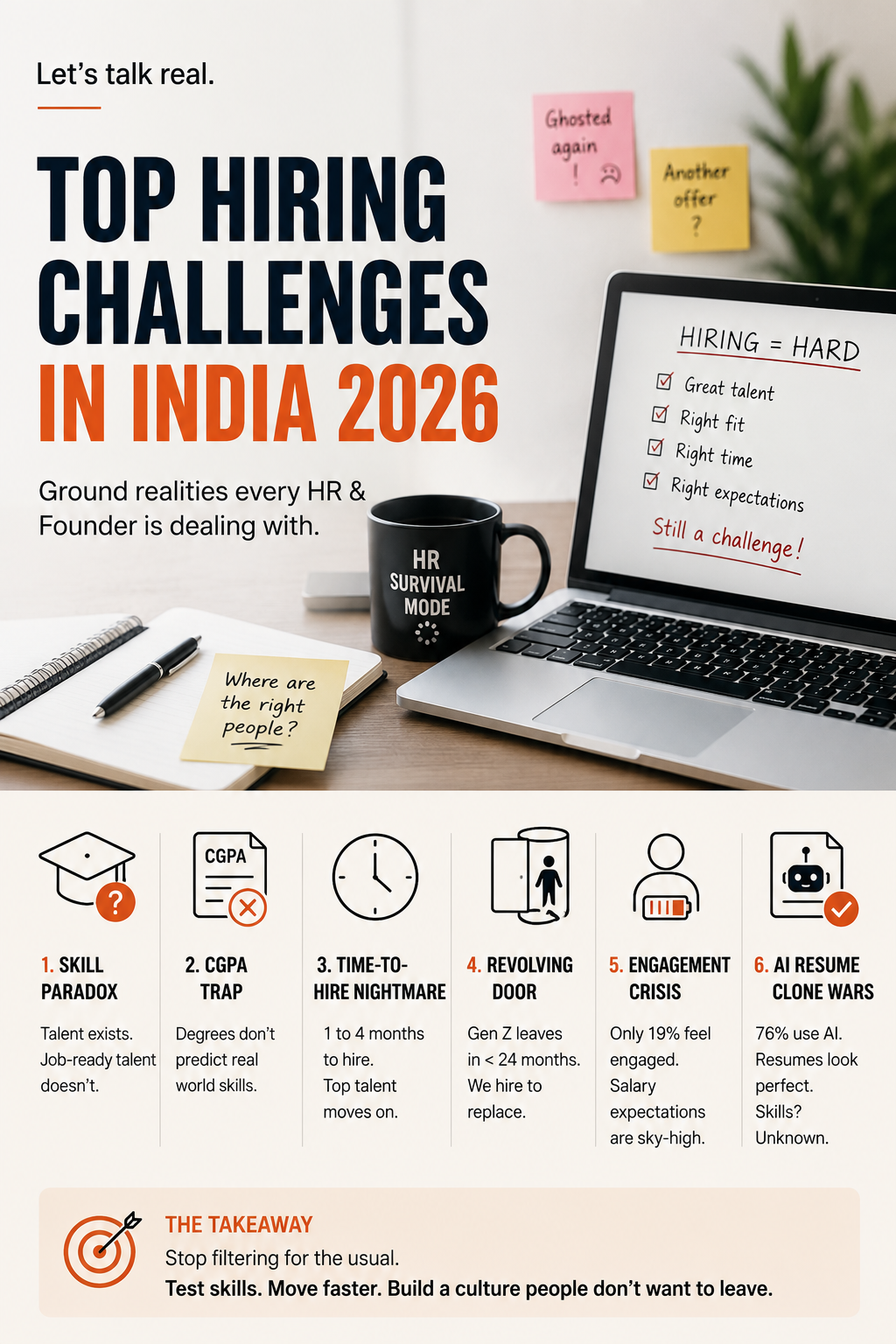
India has a massive working-age population, yet companies are still struggling to find the right people.
The problem isn’t simply a lack of candidates. It’s a mix of skill gaps, outdated screening, slow hiring, high attrition, unrealistic expectations, and AI-powered resumes.
This blog breaks down the 6 major hiring challenges facing Indian companies in 2026:
- The Employability Gap & Talent Shortage
India has millions of graduates, but the gap between college education and industry requirements remains significant. Companies are struggling to find candidates with practical, future-ready skills such as AI, cloud computing, and cybersecurity.
Data: 82% of employers reportedly struggle to find skilled talent. India also faces a 53% AI-skills gap, while 84% of undergraduate students reportedly remain unplaced after college.
- Outdated & Inefficient Screening
Many companies still rely heavily on degrees and CGPA to filter candidates. This can eliminate self-taught and highly capable people before their actual skills are even tested.
Data: 51% of companies still consider academic degrees and CGPA a primary filter, while only 21% have fully adopted skills-first hiring.
- Long Hiring Cycles & Internal Delays
Multiple interview rounds, tests, and internal approvals can stretch hiring for weeks or even months. Meanwhile, good candidates aren’t waiting around.
Data: Recruitment can take 1–4 months. 58% of GCCs reportedly take more than 45 days to fill critical roles, with niche tech positions sometimes taking over 90 days.
- High Attrition & Replacement Hiring
Aggressive hiring competition and employee poaching are making retention harder. Companies often end up hiring simply to replace people who have already left instead of building teams for growth.
Data: Gen Z tenure in GCCs has reportedly fallen below 24 months, contributing to a 40% replacement hiring rate. For an AI role, replacing a wrong hire can cost around 50–75% of their first-year CTC.
- Workforce Disengagement & Gen Z Expectations
There is a growing gap between what young professionals expect and what companies can realistically offer — particularly around salary, flexibility, career growth, and work experience.
Data: Active workforce engagement in India is reportedly only 19%. Meanwhile, 73% of undergraduates expect starting salaries above ₹5 LPA, while only around 40% actually receive offers at that level.
- The AI Resume Paradox
AI has made it incredibly easy to create polished, ATS-friendly resumes. The problem? A great-looking resume doesn’t necessarily mean great skills.
Data: Around 76% of job applicants reportedly use AI to optimize their resumes and improve their chances of getting past ATS systems.
The Bigger Question
If resumes are becoming less reliable, degrees don’t always reflect ability, and good candidates won’t wait months…
Maybe the problem isn’t that India lacks talent.
Maybe we’re still using the wrong way to find it.

Leave A Comment